Dear Reader I hope you will find this interesting; it is interesting for me to track how ideas for these two pieces came together. There is a group on Flickr called The Persistent Thread which encourages thoughts of how certain ideas are always in the background, even if sometimes one tends to think there is neither rhyme nor reason to what one is doing. 
I recently stitched a piece based on the shape of a book spine, using marks in the snow as symbols. Watching the TV I briefly saw an image of Cyrus’ Cylinder in the British Museum and it reminded me of the shape I had been stitching. Thanks to the internet I was able to research its fascinating history. It is a pottery cylinder incised with an edict made by a Persian King after he conquered Babylon. There is some controversy over the claim that it is the first declaration of Human Rights. I jumped up in bed one Saturday morning, having already made the two pieces, to hear it mentioned in the news, as the Iranian regime would like to borrow it from the BM but politics seem to have intervened. There is a lot more to say about it, have a look at the link if you are fascinated. 
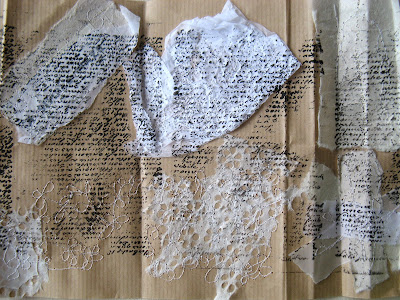
I used a photograph of an old book spine which you may have seen here before. Old accountant pages in Copperplate had been used to cover the spine of the book. I added text using lines from Cyrrus ,some from the Bill of Human Rights, and some that I used to use with people in my work i.e. ‘You Have the Right to Make Mistakes’, ‘You Have the Right to say No’, these contrasted nicely with ‘The Right to Conquer Discretely’. Calico was coated with Ink Aid to print out the image.
I shaped the material using twin needle stitching. The piece had to be made to a certain size and I ended up making two versions of this piece as I wanted the threads to hang loosely at the edges. 
Beads were made from old book pages, and eventually stitched in place with Cretan Stitch and stitches looping into the machine stitches. 
I will tell the' secrets 'of the cylinder shape and the second piece in the next instalment.
I recently stitched a piece based on the shape of a book spine, using marks in the snow as symbols. Watching the TV I briefly saw an image of Cyrus’ Cylinder in the British Museum and it reminded me of the shape I had been stitching. Thanks to the internet I was able to research its fascinating history. It is a pottery cylinder incised with an edict made by a Persian King after he conquered Babylon. There is some controversy over the claim that it is the first declaration of Human Rights. I jumped up in bed one Saturday morning, having already made the two pieces, to hear it mentioned in the news, as the Iranian regime would like to borrow it from the BM but politics seem to have intervened. There is a lot more to say about it, have a look at the link if you are fascinated.
I used a photograph of an old book spine which you may have seen here before. Old accountant pages in Copperplate had been used to cover the spine of the book. I added text using lines from Cyrrus ,some from the Bill of Human Rights, and some that I used to use with people in my work i.e. ‘You Have the Right to Make Mistakes’, ‘You Have the Right to say No’, these contrasted nicely with ‘The Right to Conquer Discretely’. Calico was coated with Ink Aid to print out the image.
I shaped the material using twin needle stitching. The piece had to be made to a certain size and I ended up making two versions of this piece as I wanted the threads to hang loosely at the edges.
Beads were made from old book pages, and eventually stitched in place with Cretan Stitch and stitches looping into the machine stitches.
I will tell the' secrets 'of the cylinder shape and the second piece in the next instalment.


 The format works very well, which is that all works have to fit into a CD case or to exact measurements if they are 3D. I understand that a new format is planned for next year. I am not always pleased with my work when I see it displayed, sometimes, what you have angst over for so long can look quite insignificant – at least that’s how I sometimes feel – but on this occasion I am pleased with my work and how it came together.


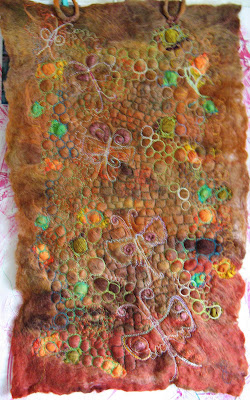


 We also used the cording foot, which was good as I have had one for years and seldom used it; the yellow and orange wool are applied with it.


 It’s basically merino with silk wisps and some beading. I don’t have my two previous bags and brooches as they were given as gifts. I did my best to give some handmade presents, which included three key rings made out of pieces of mecano by

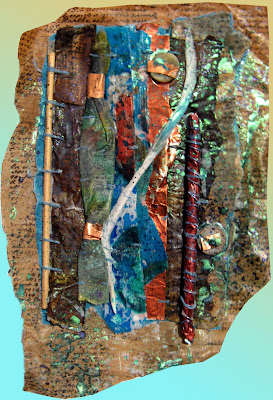 I have used Soy Wax for a recent workshop and although great for washing quickly out of fabric, and being better for the environment than other waxes, I don’t really like the smell and it seems rather soft for any collage/ embedding type work.